





 Stainless Steel Manufacturing Process
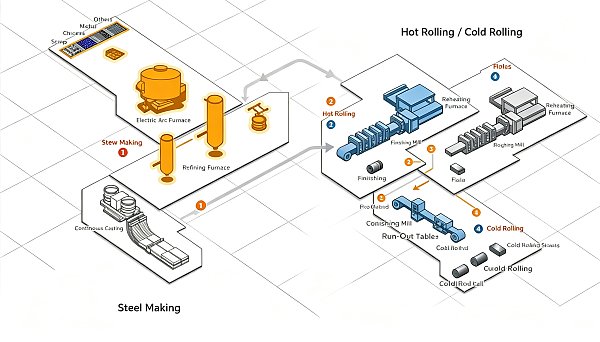
1. Steel making
Steel making is the critical process that determines the quality, performance, and cost competitiveness of steel products. SHOUYUAN is equipped with advanced AOD (Argon Oxygen Decarburization), VOD (Vacuum Oxygen Decarburization) and continuous casting facilities, enabling precise control of steel composition and superior product quality.
2. Hot Rolling
Slabs produced in the steel making plant are processed through hot rolling to form black coils with precisely controlled thickness, shape, and mechanical properties. Through advanced heat treatment, pickling, and finishing processes in the annealing and pickling line, black coils are transformed into high-quality white coils tailored to customer requirements. These products serve as premium raw materials for cold rolling, pipe manufacturing, and sheet production.
3. Plates
Steel slabs from the steel making process under go advanced rolling, heat treatment, and pickling procedures before being cut into customized sizes according to customer specifications. SHOUYUAN’s heavy plates feature excellent strength, durability, and corrosion resistance, making them widely used in demanding industries including petrochemicals, power generation, paper manufacturing, and specialized shipbuilding.
4. Cold Rolling
SHOUYUAN operates advanced cold rolling facilities equipped with 20-high cluster mills, bright annealing lines, TLL (Tension Leveling Line), AFC (Automatic Flatness Control), and AGC (Automatic Gauge Control) systems. These technologies ensure high precision and consistent quality in cold-rolled products, with thicknesses ranging from 0.1 mm to 3.0 mm and widths of up to 1,580 mm, available in various surface finishes and customized specifications.
View Video Hot Rolled Steel Manufacturing Process
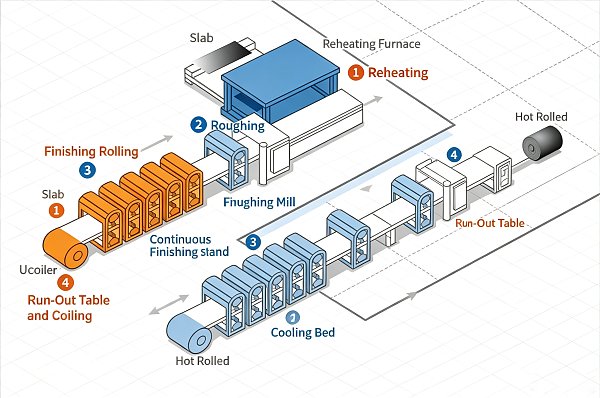
1. Reheating and Descaling
Hot-rolled coils undergo a comprehensive pickling process, where high-performance scale breakers and hydrochloric acid solutions effectively remove surface scale and oxide layers. This process eliminates potential surface defects and ensures a clean, uniform surface for subsequent cold rolling operations.
2. Rough Rolling
During the rough rolling stage, descaled slabs are processed into intermediate strips with precisely controlled shape, thickness, and width. Equipped with advanced Automatic Width Control (AWC) technology, the roughing mill’s entry and exit edgers accurately regulate strip width, ensuring dimensional consistency and stable product quality throughout the rolling process.
3. Finishing Rolling
The finishing rolling process precisely adjusts the thickness, width, and profile of steel coils to meet specified customer requirements while achieving excellent surface quality and dimensional accuracy at the targeted finishing temperature. SHOUYUAN utilizes advanced equipment, including Work Roll Shift Mills, Pair Cross Mills, and On-line Roll Grinders (ORG), to optimize productivity, improve strip shape control, and enhance the overall quality of finished coils through precise crown control technology.
4. Run-Out Table Cooling and Coiling
After passing through the finishing mill, steel strips are transported onto the run-out table for controlled cooling and coiling. Through optimized water-cooling technology, the strips are rapidly cooled to the appropriate coiling temperature, ensuring stable metallurgical properties and consistent coil quality.
View Video- Cold Rolled Steel Manufacturing Process
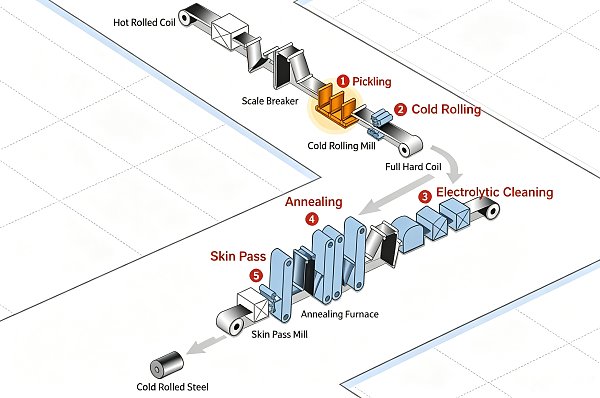
1. Pickling
Hot-rolled coils undergo an advanced pickling process, where scale breakers and hydrochloric acid solutions effectively remove surface scale and oxide layers. This process ensures a clean and uniform surface by eliminating potential defects, providing an optimal foundation for subsequent cold rolling operations.
2. Cold Rolling
After pickling, steel coils are processed through high-precision tandem cold rolling mills to achieve the required thickness, typically reducing the original material thickness by 40%–90%. Advanced automated process control systems enable precise shape adjustment, superior dimensional accuracy, and consistent product quality.
3. Electrolytic Cleaning
Electrolytic cleaning is applied to remove residual rolling lubricants, oils, and surface contaminants from cold-rolled steel. This ensures a clean surface condition and prepares the material for the subsequent annealing process.
4. Annealing
Annealing is a critical heat treatment process that restores the steel’s mechanical properties and enhances its formability. Through advanced batch annealing and continuous annealing technologies, SHOUYUAN produces cold-rolled steel products with excellent deep-drawing performance, high tensile strength, and superior surface quality.
5. Skin Pass Rolling
As the final finishing process, skin pass rolling improves surface quality, flatness, and mechanical properties by eliminating minor surface imperfections such as stretch marks. This process produces a smooth, bright, and uniform surface finish while achieving an additional thickness reduction of approximately 1%.
View Video  Electrical Steel Manufacturing Process
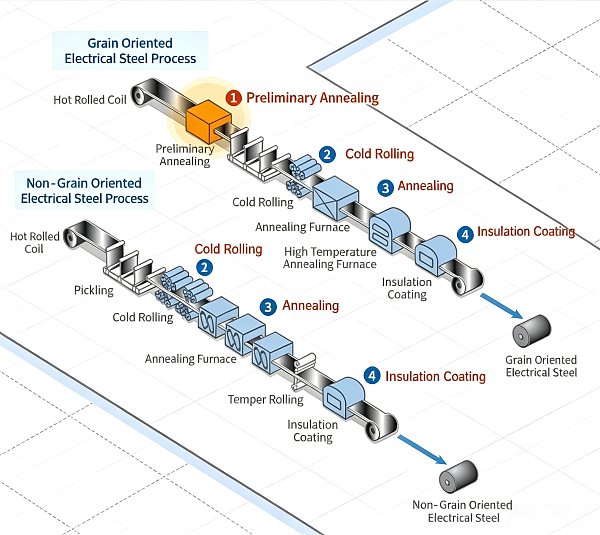
1. Preliminary Annealing and Descaling
During the preliminary annealing process, surface scale generated during hot rolling is effectively removed through scale breaking and hydrochloric acid pickling. This initial heat treatment improves the material’s cold rolling performance, refines the microstructure, and enhances the magnetic properties required for high-performance electrical steel production.
2. Cold Rolling
To achieve the required thickness, dimensional accuracy, and mechanical properties, cold rolling is performed with a typical reduction ratio of 40%–90%. Advanced rolling and automatic edge-trimming systems ensure precise control of strip thickness and width, delivering excellent dimensional consistency and surface quality.
3. Annealing
Annealing is a critical heat treatment process that transforms the cold-rolled structure into a fully recrystallized microstructure, optimizing the magnetic performance of electrical steel. For grain-oriented electrical steel (GOES), two key annealing processes are applied: decarbonization annealing and high-temperature annealing.
Decarburization annealing removes excess carbon from the steel matrix and enables the formation of a uniform MgO coating, which acts as a key component in the high-temperature treatment process. Subsequent high-temperature annealing promotes secondary recrystallization, producing a highly oriented grain structure with excellent magnetic properties and low core loss.
4. Insulation Coating
An advanced insulation coating process is applied using continuous coating equipment to reduce eddy current losses and improve electrical efficiency. The coating thickness and composition are precisely controlled according to product specifications and application requirements.
For grain-oriented electrical steel, a dual-layer coating system is typically applied, consisting of a dark brown forsterite (Mg₂SiO₄) base coating and a phosphate-based insulating top coating, providing excellent insulation performance, surface quality, and magnetic stability.
For non-oriented electrical steel (NOES), customized insulation coatings with different thicknesses and compositions are selected based on specific application requirements, including motors, generators, transformers, and other electrical equipment.
View Video

Get Bulk Order Discounts
Shouyuan Steel provides reliable steel and metal products at competitive prices. Contact us for bulk order discounts, customized solutions, and professional support.

