





 Steel Plate Manufacturing Process
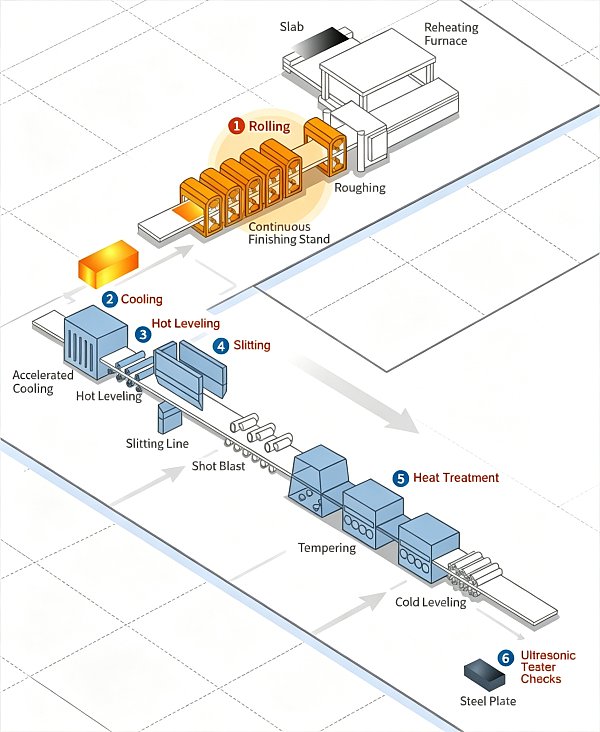
1. Rolling
Steel plates are processed through a 4-high reversible finishing mill with a maximum rolling force of 7,000 tons, enabling precise thickness control and minimizing internal defects even in heavy and thick plates. Advanced Automatic Gauge Control (AGC) and Automatic Shape Control (ASC) systems effectively reduce thickness deviation, improve flatness, and ensure consistent plate quality.
2. Accelerated Cooling
The advanced cooling system enables the production of high-strength steel plates through controlled rolling and accelerated cooling processes, eliminating the need for additional heat treatment in certain applications. Utilizing a suction-type mist cooling system, the process provides high cooling efficiency and maintains a uniform temperature distribution across the plate width, significantly improving mechanical properties and reducing quality variations.
3. Hot Leveling
Hot leveling is performed to eliminate residual stresses generated during rolling, improving plate flatness, dimensional stability, and overall product quality. This process ensures that finished steel plates meet strict requirements for precision and surface performance.
4. Cutting and Dimensioning
After cooling, steel plates undergo dimensional inspection before being cut to specified widths and lengths according to customer requirements, steel grade, and thickness. Advanced mechanical shearing and flame cutting technologies are applied to achieve high dimensional accuracy. Cutting parameters, including air knife clearance and gas torch nozzle specifications, are precisely controlled to ensure superior cutting quality and consistency.
5. Heat Treatment
To achieve the required metallurgical structure and mechanical properties, steel plates undergo customized heat treatment after surface descaling by shot blasting equipment. Advanced non-oxidizing radiation tube-type furnaces are utilized to prevent secondary oxidation and produce clean, scale-free heat-treated plates with excellent performance and reliability.
6. Ultrasonic Testing and Quality Inspection
Advanced ultrasonic testing equipment is employed to detect internal defects such as blow holes, pipes, laminations, and other discontinuities within the steel plate. This comprehensive inspection process ensures superior internal quality and guarantees that products meet stringent customer specifications and international standards.
View Video Spiral Submerged Arc Welded Pipe (SSAW) Manufacturing Process
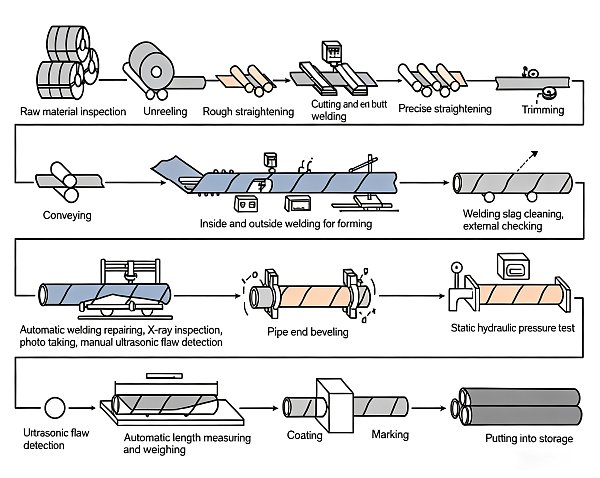
1. Uncoiling and Straightening
High-quality steel coils are carefully selected and processed through advanced straightening equipment to achieve excellent flatness and dimensional accuracy. This process provides a stable foundation for subsequent forming and welding operations, ensuring consistent pipe quality.
2. Forming
During the forming process, steel strips are gradually shaped into a cylindrical pipe through multiple forming rolls. Precise control of roll positioning, forming speed, and alignment parameters ensures accurate pipe diameter, uniform wall thickness, and reliable dimensional consistency.
3. Internal and External Welding
SHOUYUAN utilizes advanced submerged arc welding (SAW) technology and double-sided welding systems to perform high-quality internal and external welds. Automated welding control and tracking systems continuously monitor welding parameters, ensuring strong, reliable, and defect-free weld seams.
4. Pipe Cutting
After welding, pipes are accurately cut to the specified lengths using advanced cutting technology. This process ensures precise dimensions and meets customer requirements for different application standards.
5. Inspection and Quality Control
Comprehensive quality inspections are conducted using advanced testing technologies, including ultrasonic flaw detection and X-ray inspection systems, to verify weld integrity and overall pipe performance. Any detected defects are promptly repaired and re-inspected to ensure that every pipe meets required quality standards.
6. Pipe End Processing and Anti-Corrosion Treatment
Finished pipes undergo surface cleaning to remove oil, impurities, and contaminants. Advanced coating and spraying technologies are then applied for anti-corrosion protection, significantly enhancing service life and durability. Through strict processing and quality control procedures, high-performance spiral welded pipes are delivered to meet demanding industrial applications.
View Video Galvanized Steel Manufacturing Process
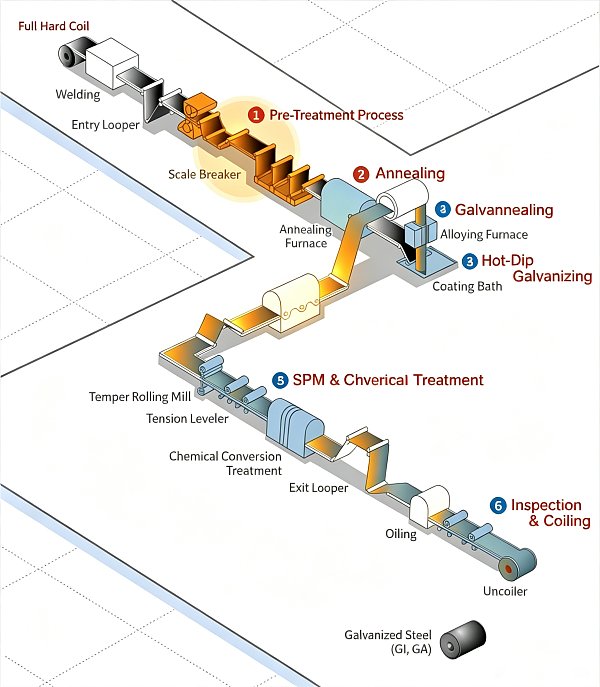
1. Pre-Treatment Process
During the pre-treatment stage, residual rolling oils, surface contaminants, and impurities on cold-rolled steel sheets are thoroughly removed. The sheets are passed through an alkaline cleaning solution under an electrically charged condition, generating an electrochemical reaction that ensures a clean and highly active surface for subsequent coating processes.
2. Annealing
The annealing process modifies and enhances the mechanical properties of pre-treated steel sheets through controlled recrystallization. This process improves material strength, ductility, and formability, providing the optimal metallurgical structure required for high-quality galvanized steel production.
3. Hot-Dip Galvanizing
After annealing, steel sheets pass through a molten zinc bath where a uniform zinc coating is applied to the surface. The coating thickness and weight are precisely controlled by removing excess zinc with a high-pressure air knife before solidification, ensuring consistent coating performance and excellent corrosion resistance.
4. Galvannealing
Following hot-dip galvanizing, the coated steel sheet undergoes a controlled reheating process to promote the diffusion of zinc atoms into the iron substrate. This forms a zinc-iron (Zn-Fe) alloy coating with enhanced weldability, paintability, and corrosion resistance, making it particularly suitable for demanding applications such as automotive manufacturing.
5. Skin Pass Mill (SPM) & Chemical Treatment
To achieve superior flatness, surface quality, and an attractive finish, galvanized steel sheets undergo skin pass rolling. A chrome-free chemical treatment is then applied to the surface to prevent white rust formation on activated zinc coatings while further improving corrosion resistance and long-term durability.
6. Inspection & Coiling
After surface treatment, galvanized steel sheets undergo comprehensive quality inspection to ensure compliance with strict requirements for surface appearance, coating uniformity, mechanical properties, and dimensional accuracy. Qualified products are then carefully coiled and prepared for shipment to customers.
View Video Electro Galvanized Steel Manufacturing Process
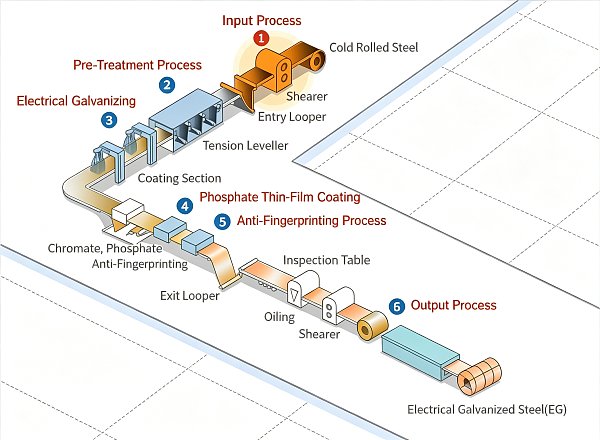
1. Input and Strip Joining Process
The entry section of the electro galvanizing line is equipped with advanced production units, including a pay-off reel, shear machine, welding machine, looper, and tension leveler. Steel coils, including cold-rolled materials, are continuously fed into the line, accurately cut, and joined through automatic welding to ensure stable and uninterrupted production.
2. Pre-Treatment Process
Before electro galvanizing, steel sheets undergo a comprehensive electrolytic cleaning process consisting of electrolytic cleaning tanks, acid pickling sections, and rinsing systems. This process effectively removes surface contaminants, residual oils, and oxide films, creating a clean and activated surface to ensure excellent coating adhesion and uniform plating quality.
3. Electro Galvanizing Process
SHOUYUAN applies advanced electro galvanizing technologies, including the CAROSEL plating method, in which zinc coating is deposited onto the steel surface through controlled electrochemical reactions using conductor rolls. This process enables the production of single-sided, double-sided, and differential-coated steel sheets with precise coating control.
In addition, horizontal electro galvanizing technology allows simultaneous plating on both sides of the steel sheet, ensuring uniform coating distribution and meeting diverse customer requirements.
4. Phosphate Thin-Film Coating
A phosphate conversion coating is applied to the zinc surface through chemical or electrochemical treatment. This thin protective film provides temporary corrosion protection while improving paint adhesion and creating an ideal surface for subsequent coating and painting processes.
5. Anti-Fingerprint Treatment
To further enhance surface performance, an organic, inorganic, or organic-inorganic hybrid coating is applied to the galvanized steel surface. This treatment improves corrosion resistance, fingerprint resistance, surface appearance, and processing performance, making the products suitable for applications requiring high-quality surface finishes.
6. Output and Packaging Process
At the exit section of the production line, finished galvanized coils pass through an output looper, tension reel, and automated packaging system. These processes ensure stable coil formation, product protection, and safe handling before delivery to customers.
View Video

Get Bulk Order Discounts
Shouyuan Steel provides reliable steel and metal products at competitive prices. Contact us for bulk order discounts, customized solutions, and professional support.

