





 Wire Rod Manufacturing Process
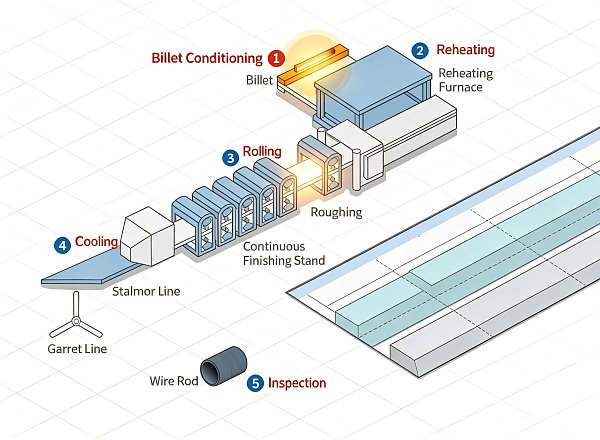
1. Billet Conditioning and Quality Inspection
High-quality billets undergo comprehensive surface inspection and conditioning before rolling. Advanced shot blasting technology is applied to remove surface scale, while magnetic particle testing and visual inspection are conducted to identify surface defects. Any detected imperfections are eliminated through grinding. In addition, ultrasonic testing and dimensional analysis are performed to ensure internal quality control and verify billet integrity before production.
2. Reheating
Billets are precisely reheated under controlled furnace conditions to achieve the optimal temperature required for rolling. The reheating temperature and holding time are carefully adjusted according to the targeted product application. Advanced combustion control technology ensures an optimized fuel-to-air ratio, minimizing decarburization and preserving excellent surface quality and metallurgical properties.
3. Rolling
During the rolling process, key parameters including rolling temperature, reduction ratio, and deformation speed are precisely controlled to achieve the required mechanical properties and dimensional accuracy. Advanced rolling technologies, including optimized roll gap adjustment, roll surface control, crack detection, and dimensional correction systems, ensure superior surface quality and consistent product performance.
4. Controlled Cooling
After rolling, wire rods undergo controlled cooling through precise regulation of laying head temperature, cooling air flow, blower speed, and insulation cover cooling rates. The cooling process is optimized according to steel grade requirements to achieve the desired microstructure and mechanical properties.
For high-carbon steel wire rods, accelerated cooling is applied to obtain the refined microstructure required for excellent drawing performance. For low-carbon steel wire rods, controlled slow cooling ensures improved ductility and softness, reducing or eliminating the need for subsequent annealing processes.
5. Inspection and Packaging
Following rolling and cooling, finished wire rods undergo comprehensive quality inspections, including dimensional accuracy, surface condition, and material integrity testing. Samples from both the front and rear sections of the coil are evaluated to ensure compliance with customer specifications. Final packaging, labeling, and product identification are carefully inspected before shipment to guarantee safe delivery and traceability.
View Video Forged Steel Manufacturing Process
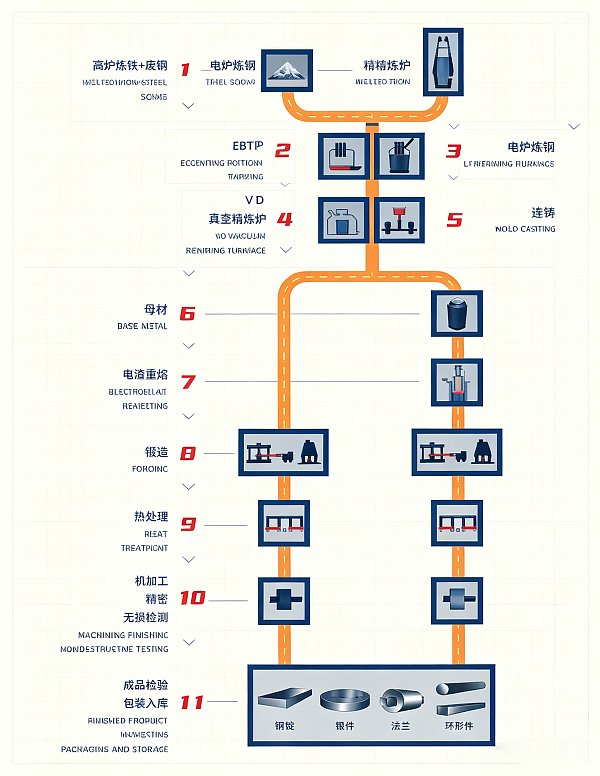
1. Heating
The forging process begins with high-quality steel billets or ingots, which are selected according to the required component specifications and final product applications. The material is heated under precisely controlled furnace conditions to achieve the optimal forging temperature, allowing sufficient plasticity while maintaining structural integrity for subsequent deformation processes.
2. Preforming
During the preforming stage, heated billets undergo preliminary shaping through processes such as edging and blocking using hydraulic presses or forging hammers. Edging increases the effective cross-sectional area and improves material distribution, while blocking refines the preliminary shape and prepares the workpiece for final forging.
3. Finish Forging
In the final forging stage, the preformed workpiece is precisely formed within closed dies under controlled pressure. This process establishes the final geometry of the component while enhancing material density, mechanical strength, and structural uniformity. Depending on product complexity, multiple forging strokes and specially designed dies may be applied to achieve the required dimensions and performance.
4. Controlled Cooling
Controlled cooling is a critical process for optimizing the mechanical properties of forged steel. By carefully managing cooling rates, the grain structure and flow characteristics of the material are refined, resulting in improved strength, toughness, and fatigue resistance.
During closed-die forging, excess material known as flash flows outside the die cavity. As the flash cools and solidifies rapidly, it provides additional resistance that helps ensure complete die filling and improves the dimensional accuracy of the forged component.
5. Finishing and Surface Treatment
After forging, finished components undergo trimming, machining, and surface treatment processes to achieve the required dimensional accuracy and surface quality. Additional treatments, including surface protection and anti-corrosion processes, can be applied to enhance durability, corrosion resistance, and overall product appearance.
View Video

Get Bulk Order Discounts
Shouyuan Steel provides reliable steel and metal products at competitive prices. Contact us for bulk order discounts, customized solutions, and professional support.

