





1. Heating
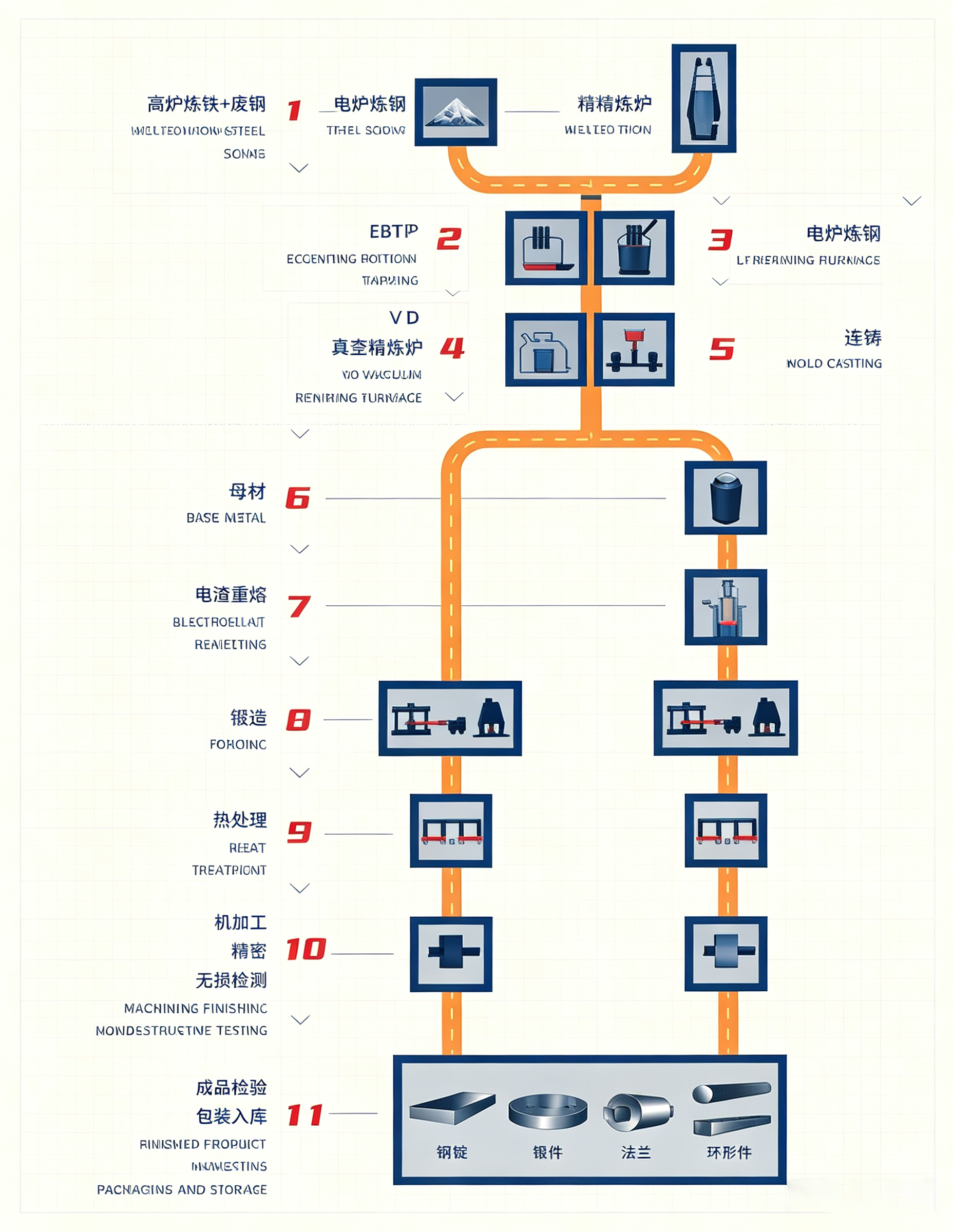
The forging process begins with high-quality steel billets or ingots, which are selected according to the required component specifications and final product applications. The material is heated under precisely controlled furnace conditions to achieve the optimal forging temperature, allowing sufficient plasticity while maintaining structural integrity for subsequent deformation processes.
2. Preforming
During the preforming stage, heated billets undergo preliminary shaping through processes such as edging and blocking using hydraulic presses or forging hammers. Edging increases the effective cross-sectional area and improves material distribution, while blocking refines the preliminary shape and prepares the workpiece for final forging.
3. Finish Forging
In the final forging stage, the preformed workpiece is precisely formed within closed dies under controlled pressure. This process establishes the final geometry of the component while enhancing material density, mechanical strength, and structural uniformity. Depending on product complexity, multiple forging strokes and specially designed dies may be applied to achieve the required dimensions and performance.
4. Controlled Cooling
Controlled cooling is a critical process for optimizing the mechanical properties of forged steel. By carefully managing cooling rates, the grain structure and flow characteristics of the material are refined, resulting in improved strength, toughness, and fatigue resistance.
During closed-die forging, excess material known as flash flows outside the die cavity. As the flash cools and solidifies rapidly, it provides additional resistance that helps ensure complete die filling and improves the dimensional accuracy of the forged component.
5. Finishing and Surface Treatment
After forging, finished components undergo trimming, machining, and surface treatment processes to achieve the required dimensional accuracy and surface quality. Additional treatments, including surface protection and anti-corrosion processes, can be applied to enhance durability, corrosion resistance, and overall product appearance.
Get Bulk Order Discounts
Shouyuan Steel provides reliable steel and metal products at competitive prices. Contact us for bulk order discounts, customized solutions, and professional support.

