





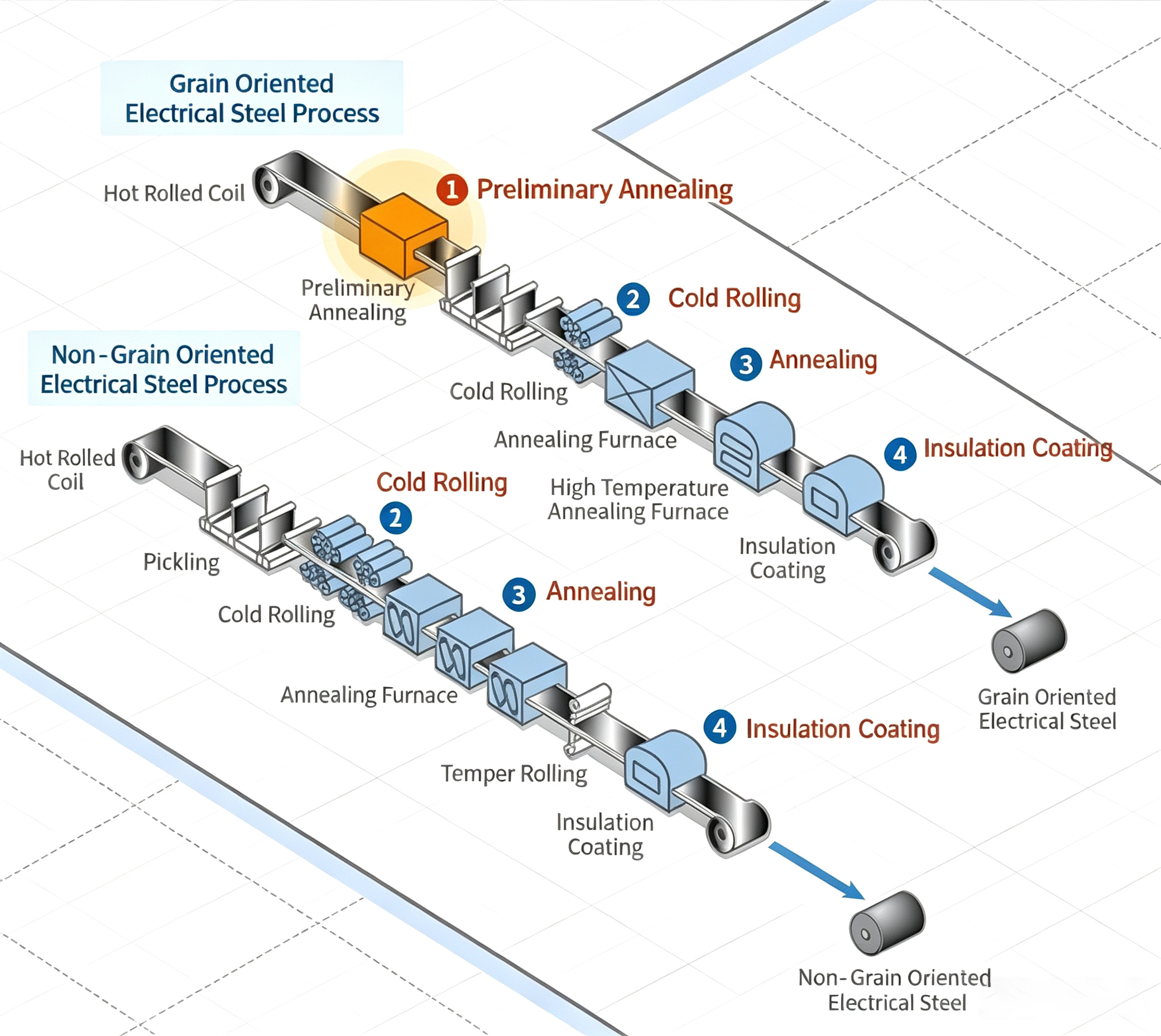
1. Preliminary Annealing and Descaling
During the preliminary annealing process, surface scale generated during hot rolling is effectively removed through scale breaking and hydrochloric acid pickling. This initial heat treatment improves the material’s cold rolling performance, refines the microstructure, and enhances the magnetic properties required for high-performance electrical steel production.
2. Cold Rolling
To achieve the required thickness, dimensional accuracy, and mechanical properties, cold rolling is performed with a typical reduction ratio of 40%–90%. Advanced rolling and automatic edge-trimming systems ensure precise control of strip thickness and width, delivering excellent dimensional consistency and surface quality.
3. Annealing
Annealing is a critical heat treatment process that transforms the cold-rolled structure into a fully recrystallized microstructure, optimizing the magnetic performance of electrical steel. For grain-oriented electrical steel (GOES), two key annealing processes are applied: decarbonization annealing and high-temperature annealing.
Decarburization annealing removes excess carbon from the steel matrix and enables the formation of a uniform MgO coating, which acts as a key component in the high-temperature treatment process. Subsequent high-temperature annealing promotes secondary recrystallization, producing a highly oriented grain structure with excellent magnetic properties and low core loss.
4. Insulation Coating
An advanced insulation coating process is applied using continuous coating equipment to reduce eddy current losses and improve electrical efficiency. The coating thickness and composition are precisely controlled according to product specifications and application requirements.
For grain-oriented electrical steel, a dual-layer coating system is typically applied, consisting of a dark brown forsterite (Mg₂SiO₄) base coating and a phosphate-based insulating top coating, providing excellent insulation performance, surface quality, and magnetic stability.
For non-oriented electrical steel (NOES), customized insulation coatings with different thicknesses and compositions are selected based on specific application requirements, including motors, generators, transformers, and other electrical equipment.
Get Bulk Order Discounts
Shouyuan Steel provides reliable steel and metal products at competitive prices. Contact us for bulk order discounts, customized solutions, and professional support.

