





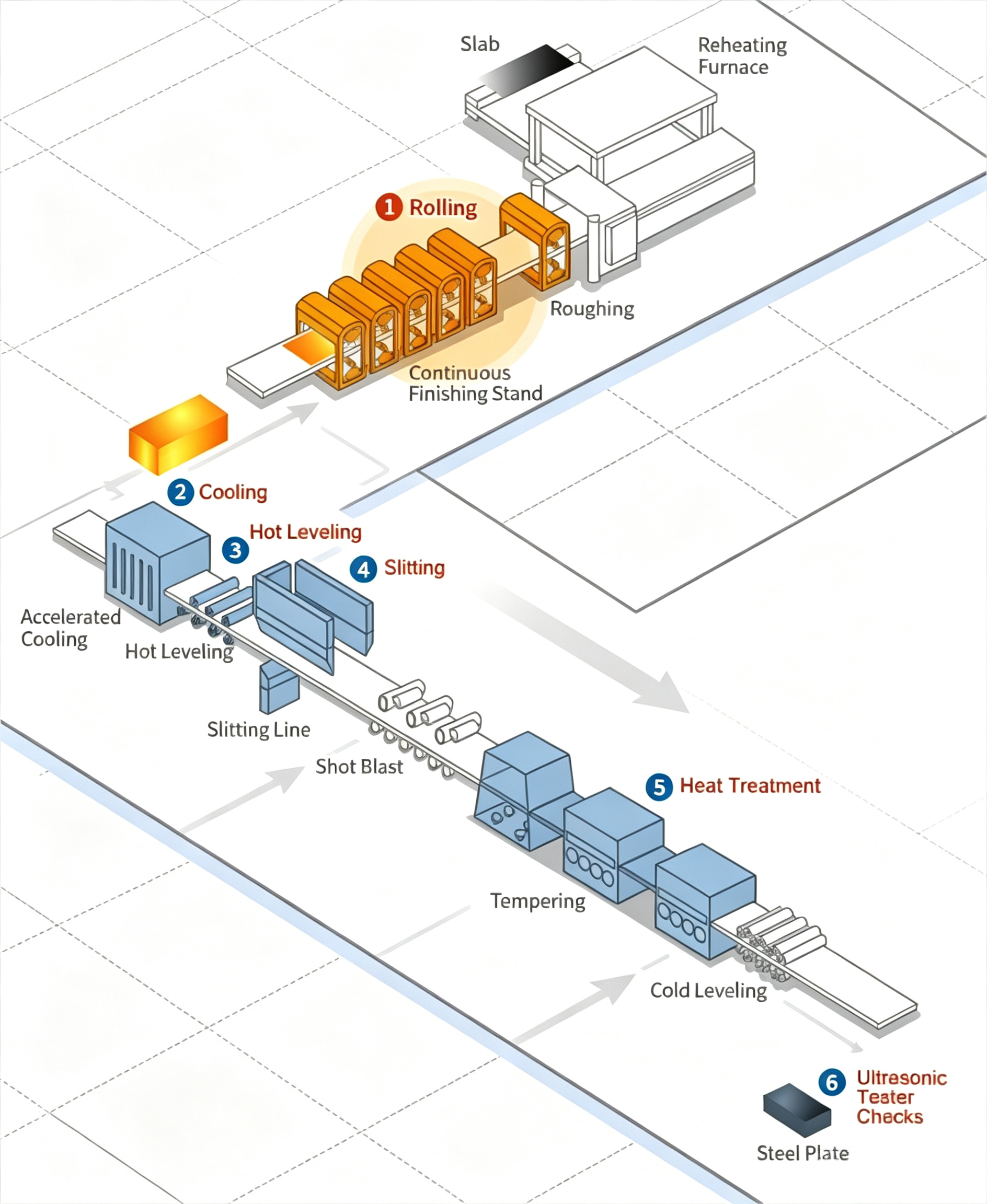
1. Rolling
Steel plates are processed through a 4-high reversible finishing mill with a maximum rolling force of 7,000 tons, enabling precise thickness control and minimizing internal defects even in heavy and thick plates. Advanced Automatic Gauge Control (AGC) and Automatic Shape Control (ASC) systems effectively reduce thickness deviation, improve flatness, and ensure consistent plate quality.
2. Accelerated Cooling
The advanced cooling system enables the production of high-strength steel plates through controlled rolling and accelerated cooling processes, eliminating the need for additional heat treatment in certain applications. Utilizing a suction-type mist cooling system, the process provides high cooling efficiency and maintains a uniform temperature distribution across the plate width, significantly improving mechanical properties and reducing quality variations.
3. Hot Leveling
Hot leveling is performed to eliminate residual stresses generated during rolling, improving plate flatness, dimensional stability, and overall product quality. This process ensures that finished steel plates meet strict requirements for precision and surface performance.
4. Cutting and Dimensioning
After cooling, steel plates undergo dimensional inspection before being cut to specified widths and lengths according to customer requirements, steel grade, and thickness. Advanced mechanical shearing and flame cutting technologies are applied to achieve high dimensional accuracy. Cutting parameters, including air knife clearance and gas torch nozzle specifications, are precisely controlled to ensure superior cutting quality and consistency.
5. Heat Treatment
To achieve the required metallurgical structure and mechanical properties, steel plates undergo customized heat treatment after surface descaling by shot blasting equipment. Advanced non-oxidizing radiation tube-type furnaces are utilized to prevent secondary oxidation and produce clean, scale-free heat-treated plates with excellent performance and reliability.
6. Ultrasonic Testing and Quality Inspection
Advanced ultrasonic testing equipment is employed to detect internal defects such as blow holes, pipes, laminations, and other discontinuities within the steel plate. This comprehensive inspection process ensures superior internal quality and guarantees that products meet stringent customer specifications and international standards.
Get Bulk Order Discounts
Shouyuan Steel provides reliable steel and metal products at competitive prices. Contact us for bulk order discounts, customized solutions, and professional support.

